
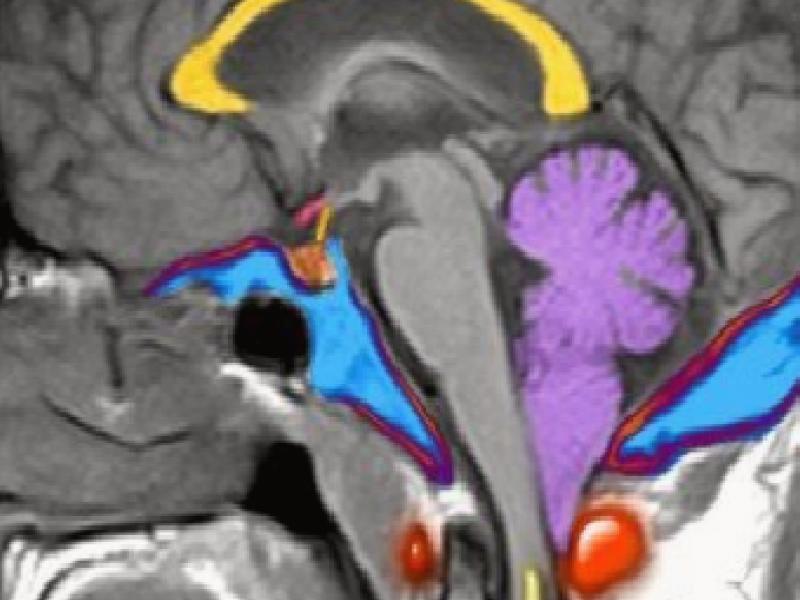

It is also called primary cerebellar ectopia. The cerebellar tonsils herniated into the upper cervical spinal canal more than 3 mm from the level of the foramen magnum. This downward slide occludes the CSF circulation between the spinal cord and the intracranial nerve. In this way, it can cause fluid accumulation in the spinal cord called syringomyelia or hydromyelia.
The incidence of the disease in the general population is less than 1 per thousand. In most of the cases, there are no complaints or findings, and it usually occurs by chance as a result of MRI scanning that area for another reason.
This downward shift occludes the CSF circulation between the spinal cord and the intracranial. In this way, it can cause fluid accumulation in the spinal cord called syringomyelia or hydromyelia.
Skull base developmental anomaly accompanies in 30 to 50% of Chiari type 1 cases. It may be present in 16-80% of patients with scoliosis and hydromyeli, especially in children
Complaints and findings
Many patients with Chiari 1 malformation do not have any complaints. In addition, one or more of the following complaints may occur together. Some of the complaints are related to the development of the syrinx (fluid-filled cavity in the spinal cord); severe head and neck pain, pain in the neck that increases with coughing, sneezing and straining, loss of pain and temperature sensation in the arms (seen in those with syrinx cavity), loss of muscle strength in the hands and arms (seen in those with syrinx cavity), falling attacks and muscle cramps. There are many tests to be done for the diagnosis of Chiari malformation, such as capsizing due to weakness, spasticity, dizziness, balance problems, double or blurred vision, increased sensitivity to bright lights
Diagnosis
.
Brainstem Evoked Responses (BAEP): It is an electrical test for the control of the hearing system, including the brain stem connection. It is revealed whether the brain stem is working properly or not.
Computerized Brain Tomography (CBT): It consists of images obtained by shaping the data obtained by using X-rays on the computer. It shows the inside of the skull and bone structures well
Magnetic Resonance Imaging (MRI): It is important for obtaining a full anatomical image and has no side effects because it uses a magnetic field. By imaging the brain, cerebellum, brain stem and spinal cord, information can be obtained about the diagnosis of Chiari I malformation and the presence of accompanying additional anomaly.
Somatosensory evoked responses (SSEP): By giving a warning, it gives information about its function by controlling the passage of the stimulus from the cerebrospinal cord and nerves.
Treatment
Surgery should not be applied to Chari I malformations that do not complain. Here, prophylactic surgery is not appropriate. Those who have pain in each neck or who have dizziness or falling attacks should not be operated on because Chiari I Malformation was detected in brain MRI. Surgery can be considered after the tests such as BAEP and SSEP are evaluated together with a neurologist and those who cause pain in the other neck, dizziness and falling attacks are distinguished. If the disease is complaining or if there is a syrinx, surgery should be performed to stop its progression.
Surgery
The aim of surgery is to reduce complaints or to stop the syrinx or increase in complaints. In the surgical treatment of Chiari I malformation, only the posterior fossa bone structure and ligaments are removed, the bone ligament and dura are opened and the dura is patched. The last treatment method is bone ligament removal, opening the dura, and closing the dura with a patch after cleaning the cerebellar adhesions.
