
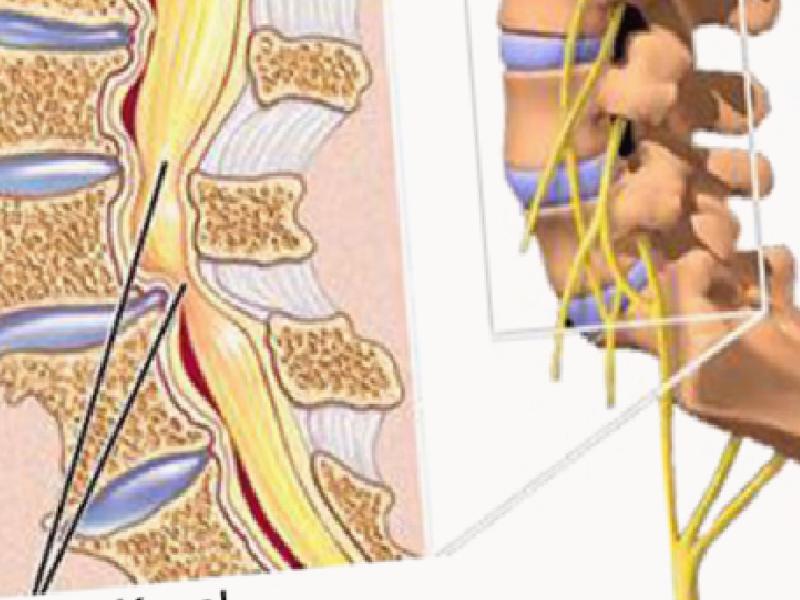
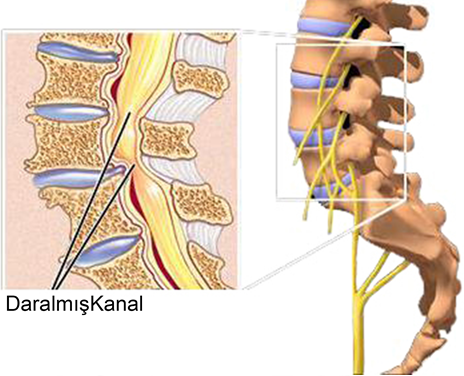
Lumbar stenosis is a disease in which the spinal canal surrounding the spinal cord gradually narrows and the spinal cord and nerves are compressed. This narrowing occurs as a result of degeneration of the intervertebral disc and facet joints. In this case, small bone protrusions called osteophytes, which are formed due to the overload on the intervertebral discs, may grow into the spinal canal and press on the spinal cord and nerves. As the facet joints also become arthritic, they widen, causing the area where the nerve roots are located to narrow. The ligaments of the spine, especially the ligamentum flavum (yellow ligament), become stiffer, less flexible and thicker as age progresses, resulting in further narrowing of the spinal canal. All these processes narrow the spinal canal, creating pressure and pressure on the nerve roots and spinal cord. causes symptoms related to narrow canal.
Stenosis is in the central part where the spinal cord or cauda equina (the lowest end of the spinal cord) is located (central stenosis), in the part where the nerve roots leave the central canal (lateral recess stenosis) or in the lateral foramen where the nerve roots come out of the canal (foraminal stenosis).
It is natural that there is a certain deterioration in the structure of the spinal canal with the advancement of age. In order for the symptoms to occur, the stenosis in the spinal canal must exceed a certain limit. In addition, the symptoms are related to the degree of pressure on the nerve structures. Despite all this, it is not necessary for everyone to have symptoms, the time and severity of symptoms may differ from person to person.
Spinal stenosis (narrow canal) can be caused by many processes that narrow the space required for neural elements in the spinal canal. The most common cause is degenerative causes. However, there are also uncommon causes of stenosis such as calcium pyrophosphate crystals and amyloid storage disease and intradural spinal tumors.
Why stenosis causes weakness and pain is still the subject of much discussion and research. It is thought that the cause of pain in the hip and leg, which is one of the common symptoms of spinal stenosis, may be the pressure on the microvascular structures that carry blood to the nerve roots. However, it is thought that the symptoms of stenosis may also be due to direct pressure on the nerve structures.
Symptoms
Some people with lumbar stenosis may not have any complaints. Some people may feel a slight discomfort in their lumbar region, and some may have difficulty walking. Patients with significant spinal stenosis, on the other hand, complain of pain in their hips, thighs, and legs that increases with standing and walking and is relieved by rest. In some patients, there may be leg pain and weakness without any low back pain. The complaints of the patients may decrease in some body positions that allow the area of the nerves to expand. This position is usually a forward lean. Therefore, these patients can use a bicycle and walk the uphill path without pain. However, their complaints usually increase when going down the stairs and down the inclined path.
The occurrence and severity of symptoms of spinal stenosis depend on many factors. These are the initial width of the spinal canal, the sensitivity of the affected nerves, the individual needs of the patient, and the patient’s tolerance for pain.
Diagnosis
Diagnosis of stenosis begins with a complete medical history and physical examination. Your doctor will determine what signs and symptoms are present and what causes these signs and symptoms to increase or decrease. The physical examination is important in determining how severe the condition is and whether it causes weakness and numbness or numbness in any part of the body. Detection of weakness or sensory disturbance in a certain part of the body by neurological examination is the most objective evidence of chronic nerve root compression due to narrow canal. There is no laboratory test that can detect the presence or absence of stenosis. X-rays of the lumbar spine are helpful in determining the degree of degeneration in the spine, which gives us an indirect idea of whether there is spinal stenosis. Direct radiographs are also helpful in determining whether there is instability in the spine.
CT shows very well the bony anatomy of the spine. For this reason, it is an indispensable tool in showing the stenosis and the location of the stenosis. MRI is a very useful method in demonstrating the condition of soft tissues and discs. ( EMG (electromyography) helps to show which nerves are involved and how much.
