

Short Facts About Our Lungs
My goal is to help patients recognize and understand their own symptoms. Because in most diseases, the ‘story’ is half the way to diagnosis.
Do you know….
The air surface area inside the lungs can fill the area of a tennis court almost 300 square meters!
The right lung has three lobes. The left lung, on the other hand, has only two lobes because the heart occupies more space.
The air entering the nose is filtered, heated and humidified. There are defense mechanisms that protect the lungs against harmful substances, dust, particles, chemicals and microorganisms throughout the entire respiratory tract.
Coughing and sneezing is also our body’s way of protecting our respiratory system from potentially harmful substances.
Your largest airway, the trachea (main windpipe), is divided into left and right branches called bronchi.
The bronchi are divided into smaller and thinner tubes called bronchioles.
The bronchioles then terminate in small air sacs called alveoli. You can imagine your lungs as tree branches (bronchi) emerging from a trunk and leaves (alveoli) on branches.
Your alveoli are a tiny air factory that constantly filters oxygen into your blood while removing Carbon Dioxide.
When you breathe, the oxygen in the air passes through the alveoli into the blood. When you exhale, polluted gases are expelled. We call this activity, which is very important for life, ‘gas exchange’.
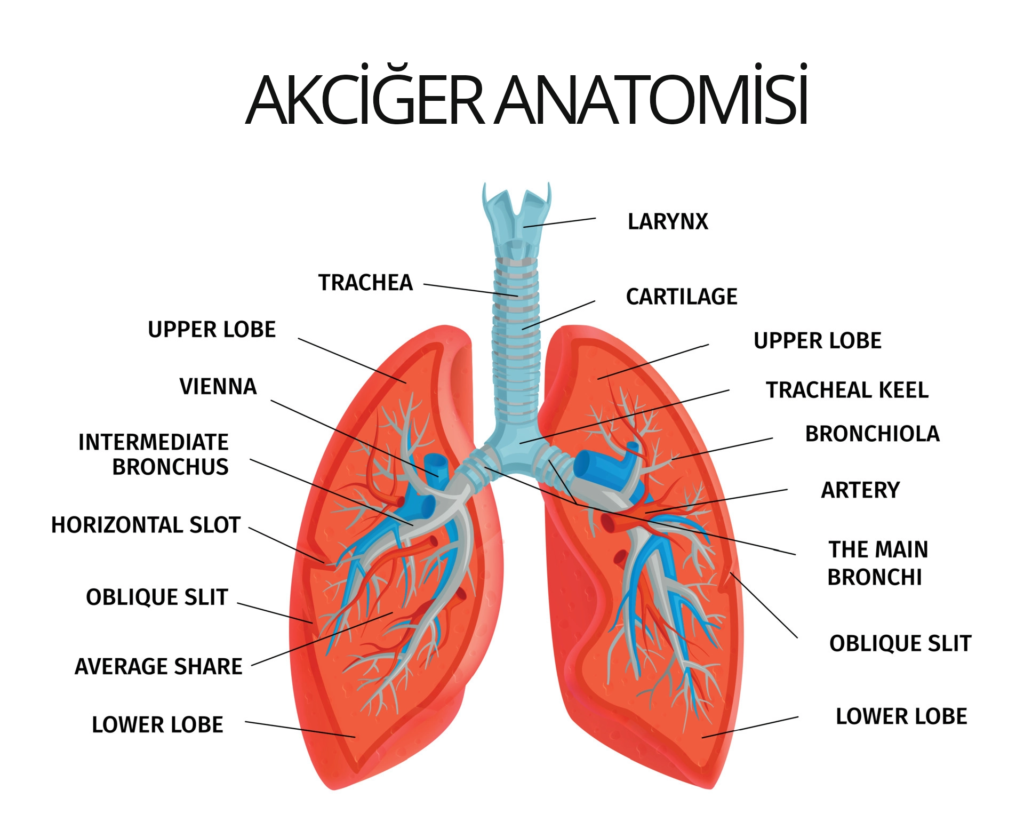
Now let’s look at the big picture and classify Lung Diseases in this way:
Lung anatomy as we just mentioned. Let’s break it down into 2 areas:
1 – Airways
2- Fleshy structure with alveoli at the end of the airways and surrounding them.
Diseases affecting the airways can be roughly classified as obstructive, diseases affecting the alveoli as restrictive.

Obstructive (obstructive) Lung Diseases:
In obstructive pulmonary diseases, the patient will have difficulty in inhaling and exhaling air. This is usually because the airways are blocked or narrowed.
Asthma
Chronic Obstructive Pulmonary Disease (COPD)
emphysema
cystic fibrosis
bronchiectasis
This group is an example of diseases.
Restrictive Lung Diseases
Restrictive lung diseases destroy the flexibility of the lungs. You can imagine the lungs as two balloons. It swells and contracts during inhalation and exhalation. Diseases that cause hardening of the lung or diseases of the thorax and pleura that make it difficult for the lung to stretch are in this group. These diseases also inhibit adequate gas exchange in the blood stream. Patients with restrictive lung disease also have difficulty breathing.
Examples of restrictive lung diseases include:

Lung fibrosis (hardening) (Idiopathic pulmonary fibrosis (IPF), pulmonary involvement of rheumatic diseases, hypersensitivity pneumonia, allergic pneumonia, etc..)
Pneumonia
sarcoidosis
Diseases affecting the lung membrane (pleural fluid accumulation, membrane thickening, membrane calcification..)
Muscular Diseases affecting the rib cage muscles (muscular dystrophy, Amyotrophic lateral sclerosis (ALS))
Spine and rib pathologies (scoliosis, kyphosis)
Asthma
In asthma, triggered by various factors, the airways narrow, the airway wall swells and produces mucus. For this reason, patients experience cough, shortness of breath and wheezing.
Triggers that initiate asthma can be: allergens, smoking, microorganisms, chemical gases, smoke, polluted air, and even one’s own stomach acid. While some people struggle with severe asthma attacks,
a large group experience their illness mildly and less frequently.
Our aim; always to protect asthma patients from exacerbations and to treat exacerbations quickly and effectively. They can learn how to identify which specific allergies, infections, or pollution are causing respiratory problems and, in this way, how to proactively avoid triggers that can lead to severe asthma attacks.
Chronic Obstructive Pulmonary Disease (COPD), Emphysema
In COPD, just as in asthma, the airways narrow, the airway wall thickens and hardens, and sputum production increases. Increased phlegm clogs the airways. In addition, in the emphysema type, the alveoli where gas exchange is provided are fragmented and as a result, the person experiences shortness of breath, sputum, wheezing and coughing. Unfortunately, unlike asthma, these damages are irreversible.
Smoking is the most common and important cause. In addition, occupational factors are also a factor in the development of COPD.
I have to remind you that if you smoke, you are in a high-risk group for COPD. Whether you are a heavy smoker or an occasional smoker, smoking is still the main cause of this disease!!!!

acute bronchitis
In acute bronchitis, which is generally caused by a virus, your bronchi become inflamed and irritated. Acid reflux, bacterial infection, or chemical irritants can also cause acute bronchitis. Similar to other lung pathologies in acute bronchitis. Cough, wheezing, phlegm, and chest pain are common symptoms.

bronchiectasis
It is the irreversible enlargement of the bronchi and their indented state due to hereditary causes (such as cystic fibrosis) or the effect of previous lung infections. This can lead to excessive sputum production and cough, copious sputum production, wheezing and shortness of breath mimicking asthma, and sometimes coughing up blood with sputum. These complaints may increase from time to time with the effect of viral or bacterial microorganisms. During these periods, the antibiotics recommended by your doctor, expectorant and breath-opening drugs will help you relax. Providing sputum drainage with respiratory physiotherapy, expectorant mucolytic drugs and postural drainage methods is one of the main principles of treatment.
Preventive vaccinations are also other things to be planned. It is an important element.
pneumonia
Inflammation of our lungs with a microorganism (it can be a virus, bacteria or fungus) is called pneumonia.
Cough, sputum, high fever, weakness, loss of appetite, headache, chest pain are the most common symptoms. However, it can be experienced in pneumonia without cough, sputum and fever. Your physician will diagnose and treat this type of table, called atypical pneumonia, using examination, laboratory and radiological methods.
Tuberculosis (TB)
Unfortunately, our country ranks high in the world in terms of the prevalence of tuberculosis. Tuberculosis is an inflammation of the lungs by a microorganism called Mycobacterium tuberculosis. It can make people sick both in childhood and adulthood.

Both clinical and radiological findings of childhood and adult tuberculosis are very different from each other. Especially in case of weakening of the immune system of people infected with TB bacillus, the bacillus wakes up and is activated.
and starts the disease in the lung. In tuberculosis, the complaints are not much different from other lung diseases. Cough, weight loss, fatigue, night sweats, fever that rises in the evening should be investigated for tuberculosis.

cystic fibrosis
Cystic fibrosis is an inherited disease. A defective gene found in patients with cystic fibrosis directly causes mucus, sweat, and digestive juices to be dense, sticky, and excess. These secretions block the airways of the lungs, making it difficult to breathe.
Lung cancer
The cells that make up living things are also born, develop and die when their time is up. Overgrowth of cells and uncontrolled cell death contribute to cancer development. These cheeky cancer cells damage and invade healthy tissue. Roughly, the cause of cancer is the cause of the disruption of the healthy birth, life and death cycle of cells.

The most important carcinogens:
smoking, chemicals, radiation, occupational and environmental exposures, diet, stress.
And of course, our genes. Cancer. Exposing the hereditary structure, which has a genetic code that is prone to development, with carcinogenic substances multiplies the risks.
Smoking is the most important factor that has been proven to cause lung cancer.
Lung cancer is still the most common cancer in the world. Early detection is also in lung cancer.
Life saver. It is necessary not to smoke and to have regular lung checks every year.
