
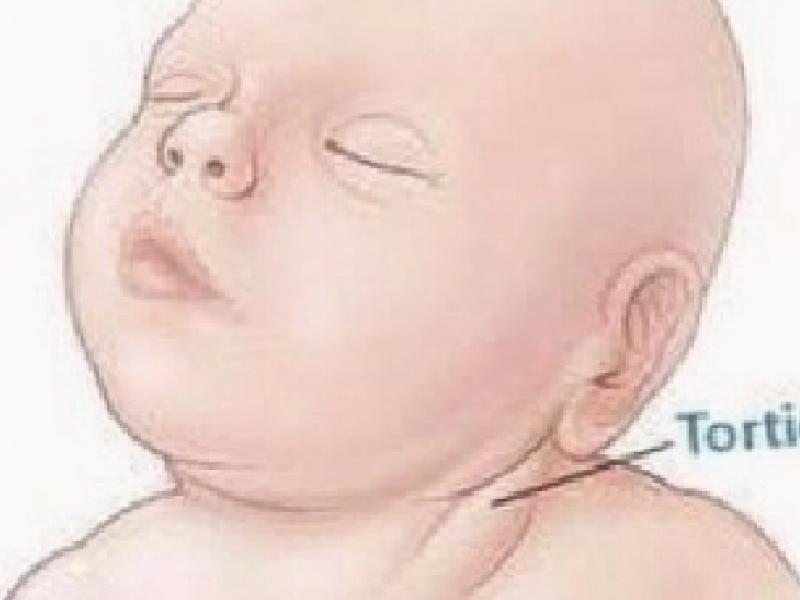
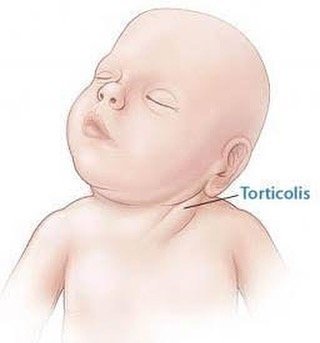
The curvature is noticeable after birth. The child’s neck is turned to the affected side, the chin is turned to the opposite shoulder. Stiffness and mass are palpable on the neck muscle (sternocleidomastoid muscle) that is involved after birth. This mass may regress over time.
It is more common in first birth or miscarriage. It is thought that it may have occurred due to posture disorder in the mother’s womb. Since these patients may have congenital hip dislocation and foot disorders, they should be investigated.
The clinic varies a lot. There are findings ranging from mild limitation of movement to excessive head deformity (plagicephaly). It may be accompanied by bat ears. Older children may come with the suspicion that there is a curvature in the waist because one shoulder is high. X-ray examination should investigate whether there is any change in the neck vertebrae, and MRI examination should be performed when necessary.
90% of patients can improve with massage and exercise and excellent results can be obtained. As soon as the diagnosis is made, exercise is described to the parents and the child’s exercise program is started. Exercises should be done gently. In addition to the stretching exercises, maneuvers that will enable the child to turn actively on the affected side should be performed. Putting the toy or television on the opposite side of the curvature, etc.
Surgery should be avoided during infancy and walking. Surgical treatment is applied in 10% of cases. Usually, surgical treatment is performed at school age. Surgery gives good results. In the surgical application, the lengthening of the neck muscle is provided. Stretching exercises should be restarted after surgery. The problem can be solved without the use of any device by giving exercise after the surgery.
Adult Torticollis
Non-congenital (congenital), the age of onset of muscular torticollis in adults is around 40 years of age, it is seen twice in women than men, and this problem is more common in women between the ages of 30-60.
The earlier the treatment is done, the better the outcome. If there are curvatures in the neck spine and one half of the face is not developed, the chance of treatment is less. It is tried to be treated with massage and neck stretching. Treatment of torticollis that does not improve with physical therapy and exercises is surgery. The age of surgery should be done as early as possible, as soon as the disease is diagnosed.
The surgery is performed under regional or general anesthesia. With a 1-2 cm incision made in the neck, the muscle part, which has become a hard cord, is removed. Stitches are removed after 1 week. If this procedure is done at an early age, it is not necessary to use a neck brace, neck curvature and facial development defect that will occur in later years are prevented.
