
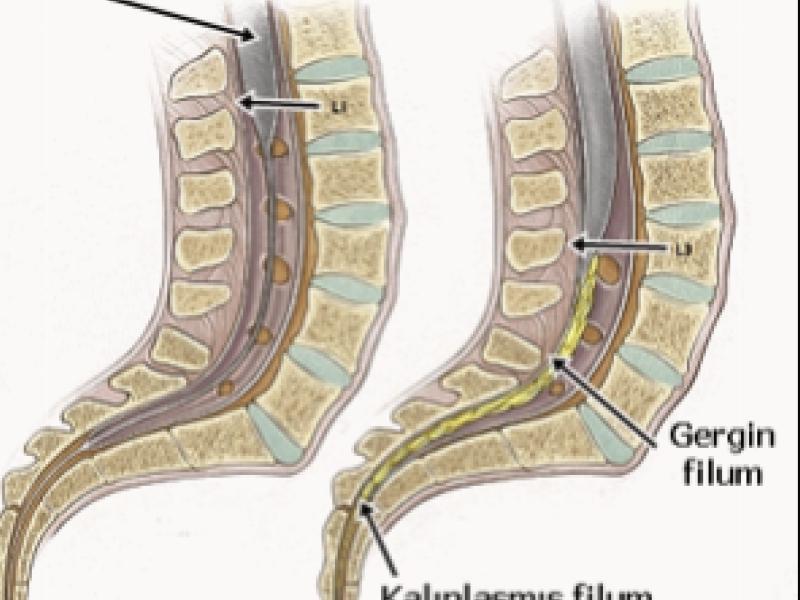
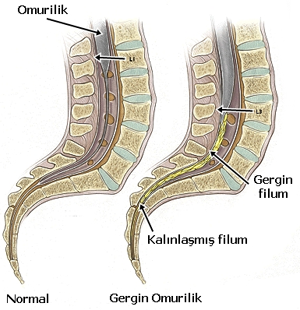
Tethered Spinal Cord Syndrome (GOS) is a group of diseases characterized by progressive neurological losses that occur with congenital or acquired spinal cord stretching.
It is a clinical picture in which progressive orthopedic deformities, weakness in the feet and legs, pain in the waist and/or legs, scoliosis and urinary-defecation defect can be seen due to the stretching of the spinal cord.
Formation of Tight Spinal Cord Syndrome
Causes such as thick filum, split spinal cord, myelomeningocele, lipomyelomeningocele that cause adhesion or stretching of the spinal cord in the womb cause stretching of the spinal cord.
In 98% of babies born at a normal gestational week, the last part of the spinal cord (conus) extends to the L2–L3 range, and in 1-2% of the babies, it extends to the L3 vertebra level. In the third month after birth, the conus is at the level of the L1–2 range, almost as in adults.
In order to make the diagnosis of tethered spinal cord, it is necessary to show radiologically that the last part of the spinal cord is below the L2-3 level. However, even if the spinal cord terminates at its normal termination site, tethered spinal cord syndrome may occur.
Lipomyelomeningocele, dermal sinus tract, thick filum, split spinal cord malformations, scar tissue and adhesions formed after myelomeningocele or lipomyelomeningocele repairs may also cause tethered cord syndrome.
Clinical Symptoms in Tight Spinal Cord Syndrome
Spinal cord is affected in tethered cord syndrome. Muscle wasting, decreased reflexes and urinary incontinence are indications that the last part of the spinal cord is affected. Pain and urological findings are prominent in patients with stretched spinal cord syndrome in adulthood. In childhood, skin findings (hair growth, capillary hemangiomas, angiomatous nevi, and atretic meningoceles, etc.), foot-leg deformities and scoliosis can be seen. In cases of Tethered Spinal Cord Syndrome, signs and symptoms may be present from birth, but may also occur at advanced ages.
Diagnosis of Tethered Spinal Cord Syndrome
MRI is the first choice radiological examination. EMG is used in the diagnosis, follow-up and surgery of the disease.
Tension Spinal Cord Syndrome Treatment
Early diagnosis and early surgery are essential in treatment. In the surgery, the spinal cord is freed by cutting the taut filum terminale, which is the spinal cord ending site.
